

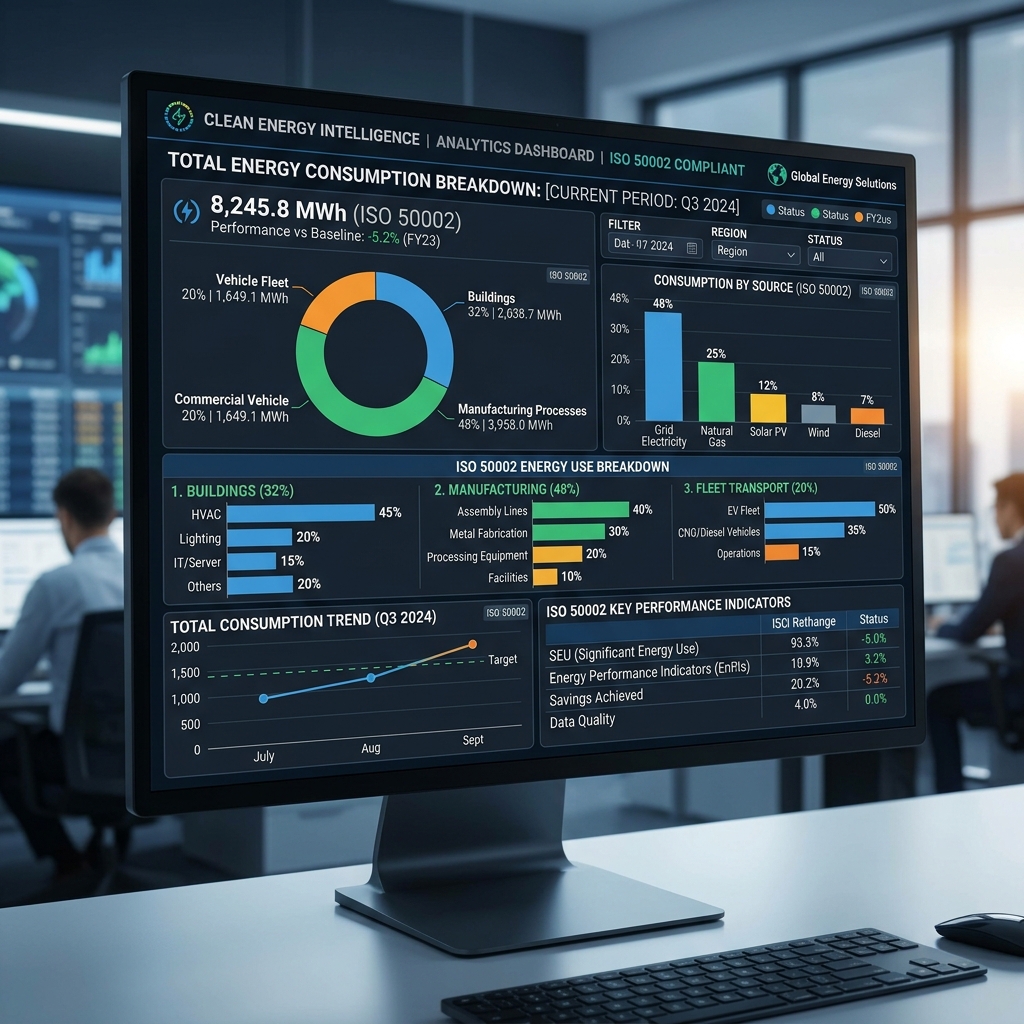
Establishing a rigorous, empirical calculation of Total Energy Consumption (TEC) is the fundamental legal requirement of the Energy Savings Opportunity Scheme (ESOS). Under Phase 4 regulations, qualifying UK enterprises must identify and account for 100% of their energy footprint, while ensuring that at least 95% of total energy consumption is covered by formal energy audits, certified ISO 50001 systems, or Display Energy Certificates (where permitted). This article provides a comprehensive technical guide to measuring energy baselines and executing ISO 50002 compliant audits. Explore our dedicated commercial energy audit services for expert technical assistance.
1. The 95% Total Energy Auditing Rule Explained
In ESOS Phase 3, organisations were allowed to exclude up to 10% of total energy consumption under the "de minimis" rule. Phase 4 strictly reduces the allowable de minimis threshold from 10% down to 5%. This means organisations must audit or certify 95% of all energy consumed across electricity, natural gas, heating fuels, process steam, and commercial transport.
2. Structuring the 3 Energy Consumption Streams
To compile an accurate ESOS baseline, energy consumption must be categorized into three distinct operational streams:
A. Buildings & Real Estate Stream
Includes all energy consumed in commercial offices, industrial warehouses, retail outlets, laboratories, and data centres. Energy sources include grid electricity, mains natural gas, fuel oil, LPG, biomass, and imported district heating or cooling. Billing data, automated meter reading (AMR) telemetry, and half-hourly (HH) data feeds must be consolidated for a continuous 12-month period overlapping 31 December 2026.
B. Industrial & Manufacturing Process Stream
Encompasses energy used in manufacturing plant, heavy machinery, process heating, industrial refrigeration, compressed air networks, thermal fluid systems, and water treatment facilities. Sub-metering data or calibrated engineering calculations are required to isolate significant energy use (SEU) assets from general building baseloads.
C. Commercial Transport & Logistics Fleet Stream
Covers all fuel and electric vehicle charging consumed for commercial transport purposes. This includes owned company vehicle fleets, leased delivery vans, heavy goods vehicles (HGVs), corporate aircraft, marine vessels, and employee-owned vehicles used for business travel (grey fleet). Fuel cards, mileage expense claims, and telematics data must be converted into kWh using official UK Government GHG Conversion Factors.
3. The ISO 50002 & BS EN 16247 Energy Audit Standards
Phase 4 regulations enforce strict quality assurance criteria for energy audits. Site surveys cannot be high-level visual walkthroughs; they must conform to international audit standards ISO 50002 (Energy audits - Requirements with guidance for use) or BS EN 16247. The ISO 50002 framework establishes a rigorous 6-stage methodology:
| ISO 50002 Stage | Technical Deliverable | Audit Quality Requirement |
|---|---|---|
| 1. Audit Planning | Scope definition & resource allocation | Establish audit boundaries, site access, safety protocols, and sampling strategy. |
| 2. Data Collection | 12-Month HH data & energy bills | Validate utility billing data, degree-day adjustments, and meter calibration records. |
| 3. On-Site Inspection | Physical asset survey & measurements | Inspect HVAC, BMS controls, lighting density, motor loads, and operating schedules. |
| 4. Energy Analysis | Energy balance models & EIR ratios | Construct energy mass balances and calculate energy intensity metrics (kWh/m²). |
| 5. ECM Identification | Costed Energy Conservation Measures | Quantify kWh savings, CapEx investment, simple payback, and carbon reductions. |
| 6. Lead Auditor Report | Defensible ISO 50002 Audit Register | Formal verification and sign-off by a certified approved ESOS lead assessor. |
4. Half-Hourly Data Profiling & Baseload Analytics
An essential capability during ISO 50002 energy audits is the analysis of half-hourly (HH) electricity consumption profiles. Advanced data analytics reveal critical operational inefficiencies, including:
- Out-of-Hours Baseload Waste: High electricity consumption overnight or during weekends when facilities are unoccupied, typically caused by unthrottled HVAC fans, uncontrolled pumps, or redundant lighting.
- Peak Demand Spikes: Sudden power draws coinciding with triad or peak tariff windows, incurring heavy capacity charges.
- Power Factor Inefficiencies: Inductive motor loads causing poor power factor (below 0.95), resulting in reactive power penalties on electricity invoices.
5. Developing a Prioritised Energy Conservation Measure (ECM) Matrix
The output of an ISO 50002 audit must feed directly into your mandatory ESOS Phase 4 Action Plan. Recommendations are structured into a 3-tier investment matrix:
- Low/Zero-Cost Quick Wins (Payback < 1 Year): BMS setpoint adjustments, heating schedule optimization, draught proofing, compressed air leak repair, and staff behavioral campaigns.
- Medium-Term Energy Efficiency Measures (Payback 1–4 Years): LED lighting upgrades with occupancy controls, variable speed drives (VSDs) on pumps and fans, boiler economisers, and pipework insulation lagging.
- Capital Decarbonisation Investment (Payback 4–8+ Years): Rooftop Solar PV installations, commercial air-source heat pump (ASHP) retrofits, battery energy storage systems (BESS), and voltage optimization transformers.